 wordpress_id: 4091
wordpress_url: http://fedetft.wordpress.com/?p=240
date: '2013-09-01 17:08:37 +0000'
date_gmt: '2013-09-01 16:08:37 +0000'
categories:
- PlanetPOuL
tags: []
comments: []
---
wordpress_id: 4091
wordpress_url: http://fedetft.wordpress.com/?p=240
date: '2013-09-01 17:08:37 +0000'
date_gmt: '2013-09-01 16:08:37 +0000'
categories:
- PlanetPOuL
tags: []
comments: []
---
One of my computers, the one I use for web browsing is a Mac. Despite that, I’ve installed Linux on it and use it instead of Mac OS almost all the time, but this is another story.
Anyway, a few days ago, my Mac simply stopped charging. I was on holiday, so I had to wait until I got back home to troubleshoot what happened. Measuring the output voltage resulted in a zero volt reading, so I opened it up.
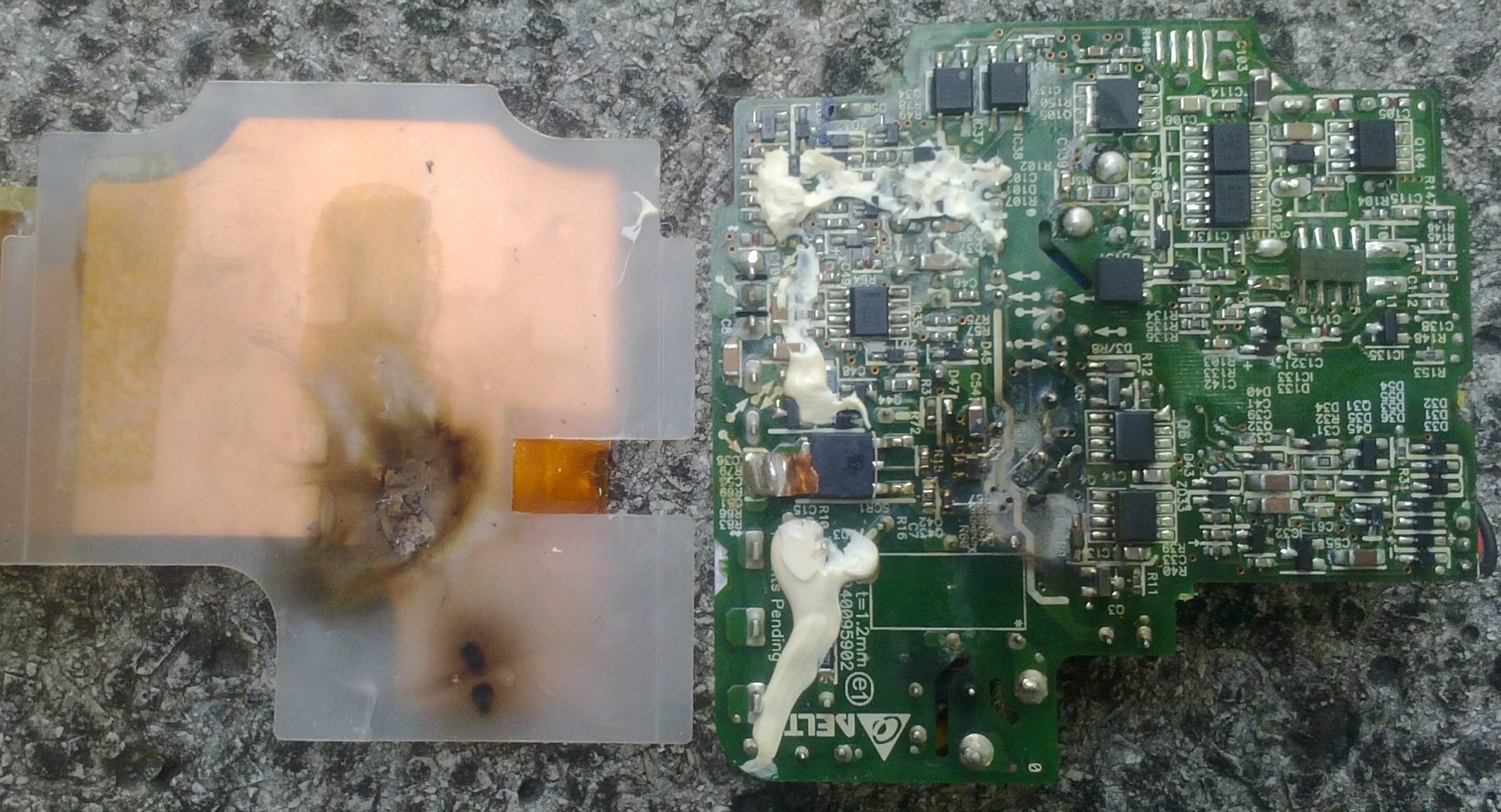
Inside I found a burnt resistor, and a blown fuse. The resistor appears to be the bleeder resistor in parallel with the input capacitor. It has likely failed resulting in a short circuit, and the fuse blew.
Now, Apple chargers are usually touted for their high quality compared to cheap chinese clones, however I wonder who thought that putting a tiny 0805 resistor in parallel on a high voltage line was a good idea…
Sure, the charger worked reliably for five years (I bought the Mac in 2008), and failed in a rather safe way (mainly thanks to the fuse) but still I think this failure mode could have been somehow forecasted, also considering that this is not the first time I see it. The other time was in an inverter, a device that produces a 230VAC output given a 12VDC input. The step-up circuit had a diode bridge rectifier, a capacitor, and a tiny 1/10W resistor (it was entirely through-hole, no SMD). One day I turned the inverter on, and heard a loud pop and a flash of light through the heat vents.
In the meantime I had to find a way to somehow power the Mac again. I cut the power cable and connected it to the only device I had lying around that could produce 16.5V at 4.6A… a cheap chinese power supply. That’s ironic, to say the least…


